
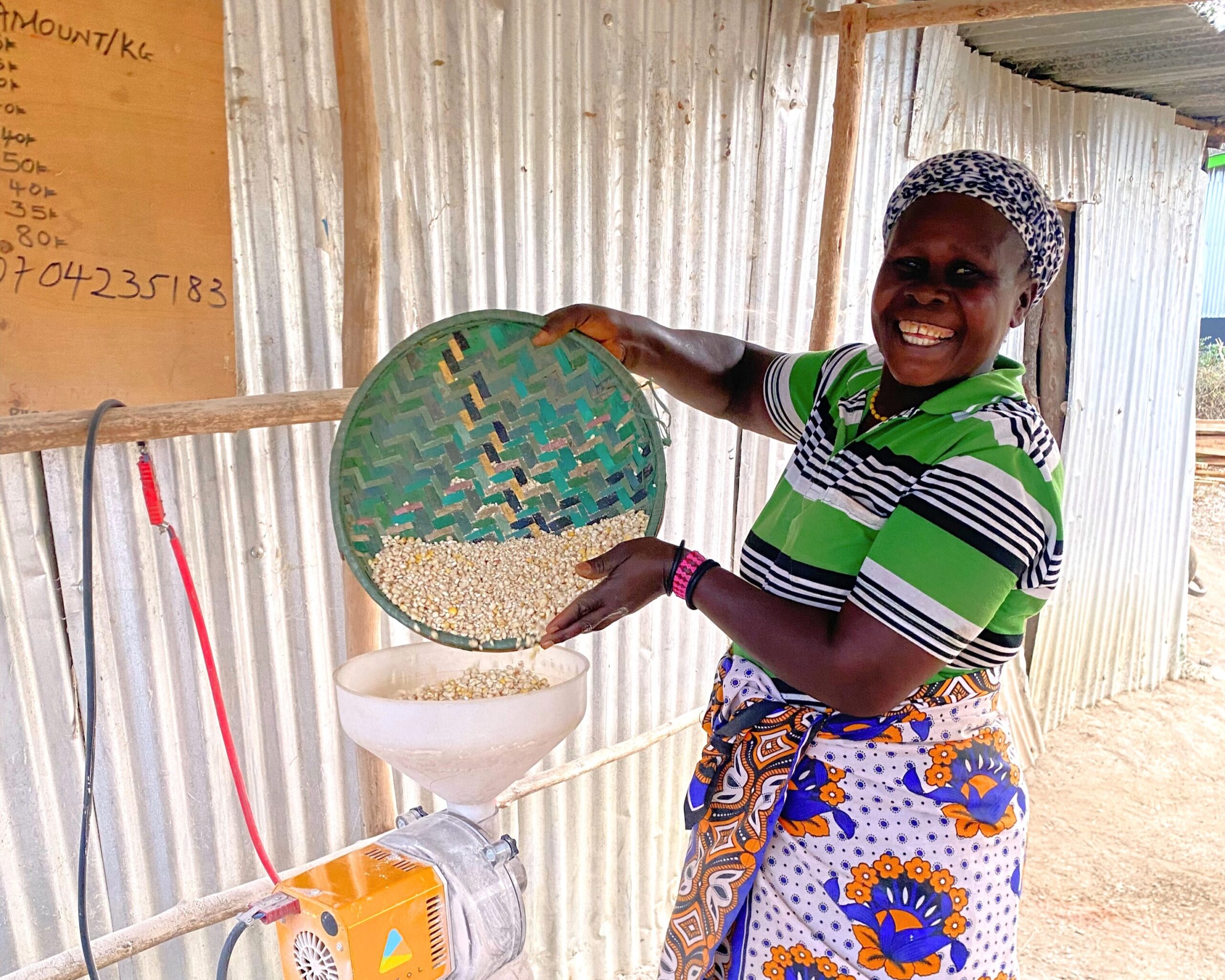


In Homa Bay, a nearly 70-year-old woman on crutches now operates a solar-powered grain mill purchased with support from her children. Rather than traveling long distances to centralized diesel mills, people in her community can now mill grain locally — often more cheaply and without waiting for enough customers to arrive before a diesel engine is switched on. Across Sub-Saharan Africa, women collectively spend an estimated 40 billion hours each year (translating to 109.6 million hours per day) accessing milling services. In many rural communities, that means carrying grain long distances, waiting in queues, and paying fuel-driven processing costs tied to centralized diesel-powered systems.
Agsol is working to change this reality through lightweight solar-powered micro-mills designed specifically for distributed rural deployment.
CEI Africa is providing Agsol with USD 209,900 in Smart Outcomes Financing to support the deployment of 400 solar-powered MicroMills that expand access to affordable local milling services while creating ownership opportunities for women entrepreneurs in rural communities.
Unlike conventional diesel mills — large machines that often require significant fuel, mechanical maintenance, and centralized operations — Agsol’s mills are compact, solar-powered, and designed for smaller-scale local use. Traditional diesel milling is often male-dominated, as ownership depends on access to fuel supply chains, technical expertise, and higher upfront capital—barriers that have historically been less available to female entrepreneurs.
The economics also look very different. Agsol estimates that conventional diesel mills can spend roughly 40% of revenue on fuel costs alone, while many rural diesel mills remain underutilized despite their large size. By contrast, the company’s solar-powered mills are designed around smaller, distributed local networks that bring processing closer to where people actually live.
By supporting companies like Agsol, CEI Africa is helping reduce dependence on diesel, lower milling costs, shorten travel and wait times, and expand localized food processing capacity. For women entrepreneurs, this also creates access to ownership opportunities in a sector where participation has historically been constrained by the economics and logistics of diesel-powered infrastructure.