
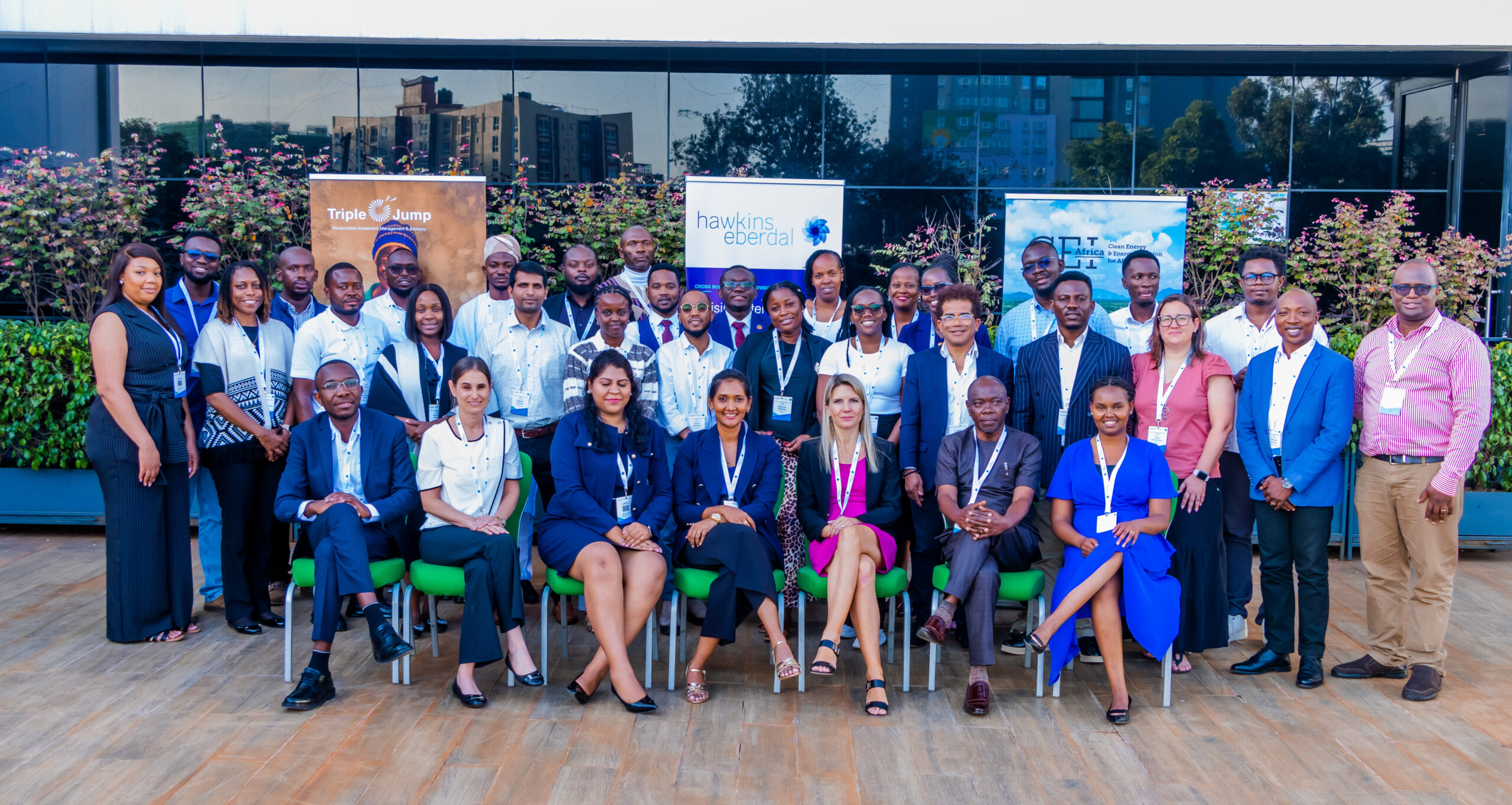


Reflections from the CEIA Financial Modelling Pillar workshop, Nairobi, 25–27 May 2026
Capital does not follow ambition. It follows credibility.
For green mini-grid companies operating across Sub-Saharan Africa, the operational track record and impact they create are increasingly visible. Reliable electricity is being delivered to communities previously beyond the reach of the grid, remote monitoring systems are increasingly being adopted, customer numbers are growing and tariff structures are evolving as companies move from early-stage towards scale.
And yet, the gap remains between operational progress and access to capital. Investors and lenders walk away from opportunities because they cannot clearly assess the risks, returns and structures that sit behind them. A robust financial model is one of the key tools for closing that gap. Far more than a spreadsheet, it translates the technical, operational and commercial assumptions of a business into a structured and transparent view for investors and lenders to engage with, interrogate and trust.
In that context, targeted technical assistance can deliver critical value by helping companies move from operational momentum to stronger financial models, and building credible engagement with capital providers.
The CEIA Financial Modelling Pillar, established under the CEI Africa Technical Assistance Facility, was designed to close that gap. Delivered by Hawkins Eberdal as technical lead, and developed in collaboration with the Africa Minigrid Developers Association (AMDA), the programme works directly with mini-grid companies to strengthen their financial modelling, valuation and investor readiness capabilities.
From 25 to 27 May 2026, 21 mini-grid and clean energy companies gathered in Nairobi for the in-person component of the programme: three intensive days of hands-on financial modelling training, working through a standardised model architecture, from foundations to investor-facing outputs.
Day One: Foundations and revenue build
The first day established the principles that underpin good financial modelling, with a focus on the architecture and timing decisions that determine whether a model can be relied upon as projects evolve.
Participants worked through the differences between project finance and corporate finance within a mini-grid context, the principles of model transparency and audit-readiness, and the construction of a structured timeline that supports both project-level analysis and portfolio-level decision-making.
The afternoon moved into the revenue build, where participants modelled generation assumptions, customer demand, connections, tariffs, indexation and revenue calculations directly within their own models.
A particular highlight was the crowdlender perspective shared by Energise Africa, which gave participants direct insight into what investors look for in an investment-ready financial model, and the most common reasons models are returned for revision.
Day Two: Costs, capital and financing structures
With the revenue build in place, the second day moved into the structures that determine whether a project is financeable.
Participants worked through operating expenditure and capital expenditure builds, before progressing into the mechanics of senior debt: drawdowns, tenor, grace periods, repayment profiles, interest calculations and financing fees. The session then moved into equity, fixed grants and Results-Based Financing (RBF), with a particular focus on building the RBF module from first principles, including per-connection payments, eligibility flags and cumulative tracking.
For many developers, these financing components represent the difference between a technically viable project and an investable one. Understanding how each source of capital interacts within a project structure, and how that structure can be tested, is essential to engaging with lenders and investors with confidence.
Day Three: From model to investment case
The final day shifted focus from the mechanics of the model to the outputs that investors use to evaluate opportunities.
Participants built the cashflow waterfall, including operating cashflow, capex, funding flows, debt service and cashflow to equity, alongside the Debt Service Coverage Ratio (DSCR) framework that anchors covenant monitoring. From there, the session moved into valuation, with participants producing project and equity return calculations using FCFF, discount rates, NPV and IRR at both project and equity level.
The day closed with scenario and sensitivity analysis, where participants built a scenario manager covering downside cases, stress tests and an investor-ready scenario pack. This is where a financial model stops being a spreadsheet and becomes a decision-making tool: a structured environment within which assumptions can be tested, downside cases interrogated, and investor questions answered with confidence.
Beyond the workshop
The Nairobi workshop is one component of a broader programme. Each of the 21 participating companies now moves into one-on-one technical assistance: enabled through CEIA’s funding, the Hawkins Eberdal team will provide hands-on support to refine, stress-test and strengthen their own financial models, business planning processes and investor readiness strategies.
This continuity matters. A three-day workshop, however intensive, can establish principles and methodology, but the work of building a genuinely investor-ready financial model is iterative. Assumptions need to be reviewed against operational data. Scenarios need to be refined as fundraising conversations progress. Investor questions need to be answered through the model itself, not around it.
The cohort brings together companies from Uganda, Rwanda, Sierra Leone, Nigeria, Zambia, Cameroon, Madagascar, Kenya, the Democratic Republic of Congo, Lesotho, Tanzania and South Africa: 12 countries, 21 businesses, and a shared challenge of accessing the capital required to scale.
Closing the credibility gap
Improving financial modelling capability across the mini-grid sector is not, ultimately, about building better spreadsheets. It is about helping companies that already know their businesses inside out to express that knowledge in the language of investors.
Closing that credibility gap, one model at a time, is what unlocks access to capital, accelerates investment decisions, and supports the growth of a stronger and more resilient mini-grid sector capable of delivering energy access at the scale Sub-Saharan Africa requires.
The CEIA Financial Modelling Pillar is a step toward that goal. The work continues now with the cohort, into the next phase of the programme.